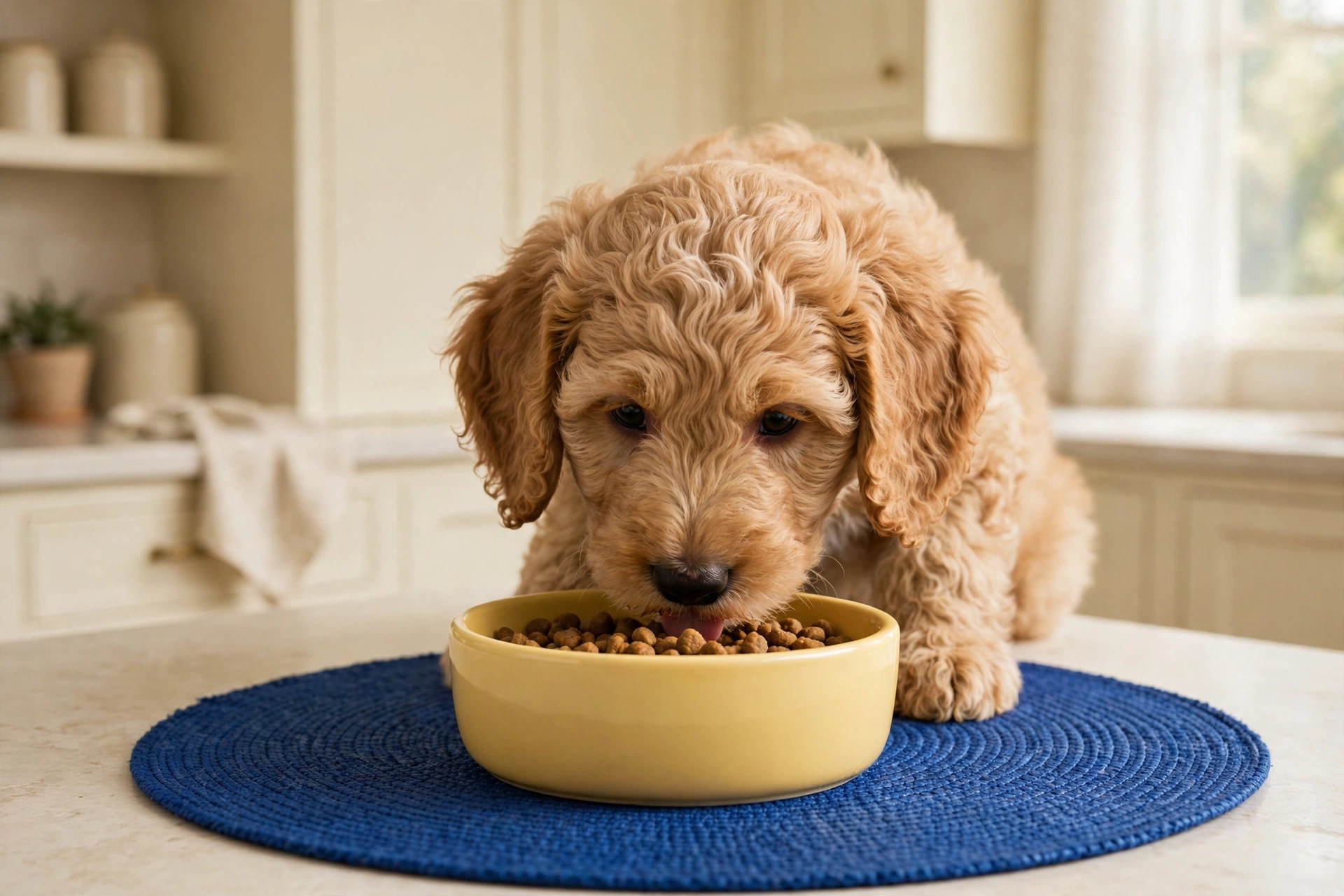
Best Food for a Goldendoodle Puppy: 9 Picks That Actually Work (2026)
Affiliate disclosure: As an Amazon Associate I earn from qualifying purchases. I get commissions for purchases made through links in this post — at no extra cost to you. Prices below are US street-price ranges as of Nov 2026.
Direct answer: The best food for a Goldendoodle puppy is a large-breed puppy formula — for most standard doodles, Purina Pro Plan Large Breed Puppy ($55–$75 per 34 lb bag) is the safest first pick. Large-breed puppy food controls calcium and calories, which matters because fast growth in a large puppy raises the risk of hip and joint problems later. Feed 3–4 small meals a day until 6 months, then 2 meals a day. If your doodle is a mini (expected adult weight under 50 lb), use a small/medium-breed puppy formula instead — same brands, different bag. Fresh food (Ollie, Farmer’s Dog) is the premium option, at $40–$60 per new-customer order, and works best as a topper or a full switch once the puppy is settled.
Why “large breed puppy” matters for a doodle
A standard Goldendoodle usually grows to 50–90 lb as an adult. That puts it in the large-breed category, and large-breed puppies should not eat regular adult food or all-life-stages food with uncontrolled calcium. Too much calcium and too many calories in the first year can make bones grow too fast, which is linked to hip dysplasia and joint trouble in large dogs. So the first rule is simple: buy a bag that says “large breed puppy” on it — unless your doodle is a mini, in which case buy “small/medium breed puppy”. If you are unsure of your puppy’s expected adult size, ask your breeder for the parents’ weights, or ask your vet at the first visit. Do not guess from the puppy’s size at 8 weeks.
Quick comparison table
| Product | Price | Type | Best for |
|---|---|---|---|
| Purina Pro Plan Large Breed Puppy | $55–$75 / 34 lb | Kibble | Best overall, most puppies do well on it |
| Hill’s Science Diet Puppy Large Breed | $55–$80 / bag | Kibble | Vet-recommended, sensitive stomachs |
| Royal Canin Medium / Large Puppy | $60–$90 / bag | Kibble | Picky eaters, breed-size formulas |
| IAMS Proactive Health Large Breed Puppy | $40–$55 / bag | Kibble | Budget pick, still large-breed controlled |
| Purina Pro Plan Sensitive Skin & Stomach (Salmon) | ~$70 / bag | Kibble | Itchy skin, sensitive stomach — adult transition |
| Ollie | $40–$60 per new-customer order | Fresh, delivered | Premium fresh food, picky puppies |
| Farmer’s Dog | $40–$50 per new-customer order | Fresh, delivered | Premium fresh food, portioned by weight |
| Nom Nom | ~20% commission, fresh | Fresh, delivered | Fresh food with vet nutritionist plans |
| Blue Buffalo Life Protection Puppy | $50–$70 / bag | Kibble | Grain-inclusive, widely available |
Prices are ranges, not fixed prices. Fresh-food prices are per order and depend on your dog’s weight and plan — check the current price on the brand’s site.
1. Purina Pro Plan Large Breed Puppy — Best overall
Price: $55–$75 per 34 lb bag. The default first pick for a reason: it is a large-breed puppy formula from a brand with feeding trials behind it, it is widely available, and most puppies eat it without fuss. If your puppy came home eating something else, transition slowly rather than switching on day one. Pros: large-breed calcium/calorie control; easy to find; good value per pound. Cons: contains chicken — if your puppy is itchy, chicken is the first suspect to discuss with your vet. Buy it if: you want one safe, no-drama first food for a standard doodle.
Check current price
2. Hill’s Science Diet Puppy Large Breed — Best for sensitive stomachs
Price: $55–$80 per bag. Another feeding-trial brand, often the one vets stock in their own clinics. A good pick if your puppy has soft stools on other foods, or if your vet already recommended Hill’s. Pros: gentle on digestion; consistent quality bag to bag. Cons: a little more expensive per pound than Pro Plan. Buy it if: your puppy’s stomach is unsettled, or your vet suggested it.
3. Royal Canin Medium / Large Puppy — Best for picky eaters
Price: $60–$90 per bag. Royal Canin splits its puppy food by expected adult size, so you buy the bag that matches your doodle — Medium Puppy for minis, Large Puppy for standards. Puppies that turn their nose up at other kibble often eat this one. Pros: size-specific formulas; very palatable. Cons: the most expensive kibble here. Buy it if: your puppy refuses other kibble, or you want the size-matched formula.
4. IAMS Proactive Health Large Breed Puppy — Best budget pick
Price: $40–$55 per bag. The cheapest large-breed puppy formula on this list that still controls calcium and calories properly. A sensible pick if you are feeding a fast-growing standard doodle and going through a bag every two weeks. Pros: cheapest per bag; still a proper large-breed formula. Cons: fewer protein options; some puppies prefer Pro Plan’s taste. Buy it if: budget matters and your puppy eats it happily.
5. Fresh food: Ollie, Farmer’s Dog, Nom Nom — The premium option
Price: Ollie $40–$60, Farmer’s Dog $40–$50 per new-customer order; Nom Nom priced by plan. Fresh food is cooked, portioned by your puppy’s weight and age, and delivered frozen. It is the best-tasting option on this list, and the easiest way to get a picky puppy eating. It is also the most expensive per day, and you need freezer space. Do not start fresh food in the first week home — let the puppy settle on its breeder’s food first, then transition. A cheaper middle step is to use fresh food as a topper: a spoonful on top of kibble. Pros: very palatable; portioned for your dog; good for picky eaters. Cons: expensive; needs freezer space; delivery subscription. Buy it if: your puppy will not eat kibble, or you want fresh food and the budget allows it.
6. How much to feed — by age
Use the bag’s feeding chart as a starting point, then adjust by body condition: you should be able to feel the ribs easily under a thin layer of fat, and see a waist from above. If you cannot feel the ribs, feed a little less. If the ribs are visible, feed a little more.
| Age | Meals per day | Notes |
|---|---|---|
| 8–12 weeks | 4 meals per day | |
| 3–6 months | 3 meals per day | |
| 6–12 months | 2 meals per day | |
| 12+ months | 2 meals per day | Switch to an adult large-breed formula |
Mini doodles need less — use the small/medium-breed chart on the bag, not the large-breed one. These are starting points, not a prescription: your vet’s advice for your puppy beats any chart.
7. How to switch foods without an upset stomach
- Days 1–2: 75% old food, 25% new food.
- Days 3–4: 50% old, 50% new.
- Days 5–6: 25% old, 75% new.
- Day 7: 100% new food.
If stools go soft, go back one step for two days, then move forward again. Never switch food and start a new treat, a new chew, and a car trip in the same week — if the stomach goes wrong, you will not know which change caused it.
8. What not to feed a puppy
- Adult dog food — wrong calcium and calorie levels for a growing large-breed puppy.
- Grain-free food, unless your vet tells you to — the FDA has investigated a possible link between grain-free diets and heart disease in dogs; discuss it with your vet before choosing grain-free.
- Raw food for a puppy — higher risk of bacteria for a young immune system, and hard to balance calcium correctly at home.
- Cooked bones, grapes, raisins, chocolate, xylitol (birch sugar), onions, garlic — all toxic or dangerous for dogs. Keep them out of reach.
- Too many treats — treats should be under 10% of daily calories. Training treats add up fast with a puppy.
FAQ
How much should a Goldendoodle puppy eat per day?
Follow the large-breed puppy chart on the bag for your puppy’s expected adult weight, split into 3–4 meals under 6 months and 2 meals after that. Adjust by body condition — ribs easy to feel, waist visible from above.
Is Purina Pro Plan good for Goldendoodle puppies?
Yes — Pro Plan Large Breed Puppy is a feeding-trial-backed large-breed formula and the most common first pick for standard doodles. If your puppy is itchy on it, talk to your vet about a chicken-free option.
When should I switch my Goldendoodle puppy to adult food?
Around 12 months for standard doodles (some vets say 12–18 months for large breeds), and around 9–12 months for minis. Switch gradually over a week, as in the section above.
Can Goldendoodle puppies eat grain-free food?
Only if your vet recommends it. Grain-free diets have been linked in FDA investigations to heart problems in some dogs, so do not choose grain-free by default.
Is fresh food better than kibble for a puppy?
Fresh food is more palatable and well-portioned, but it costs much more and needs freezer space. A good large-breed kibble is nutritionally complete for a puppy — fresh food is a premium choice, not a requirement.
The short version
Standard doodle → large-breed puppy formula (Purina Pro Plan Large Breed Puppy first). Mini doodle → small/medium-breed puppy formula, same brands. Sensitive stomach → Hill’s Science Diet Puppy Large Breed. Picky eater → Royal Canin or fresh food (Ollie / Farmer’s Dog) as a topper. Whatever you buy, switch over 7 days, feed 3–4 meals under 6 months, and check with your vet at the first visit.